
Microlight » Aircraft Tech Knowledge » Basic Aerodynamic Theory
Basic Aerodynamic Theory
Aerofoil Description
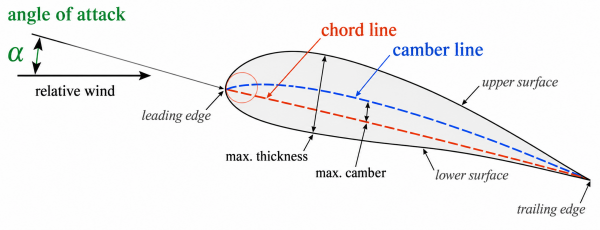
- Leading Edge - the front edge of the aerofoil which first meets the airflow.
- Trailing Edge - the rear edge of the aerofoil.
- Chord - an imaginary straight line joining the leading edge and trailing edge.
- Thickness - the maximum distance between the upper and lower surfaces of the aerofoil.
- Camber - the curvature of the aerofoil.
- Angle of Attack - the angle between the chord line and the Relative Airflow (RAF).
Lift
Lift is the aerodynamic force produced by an aerofoil acting perpendicular to the Relative Airflow.
In normal flight, lift acts mainly upwards and supports the weight of the aircraft.
Lift is produced as the aerofoil moves through the air and creates a pressure difference between its upper and lower surfaces.
The amount of lift produced is affected by:
- airspeed
- air density
- wing area
- angle of attack
- aerofoil shape
Indicated Airspeed (IAS) and Air Density
Indicated Airspeed (IAS) is closely related to the dynamic pressure acting on the aircraft.
Dynamic pressure depends on:
- air density
- airspeed
As altitude increases, air density normally decreases.
If a pilot maintains the same IAS, the aircraft must travel at a higher True Airspeed (TAS) through the less dense air to produce approximately the same dynamic pressure.
To see more, you must subscribe for licence "Microlight" or sesssion "Aircraft Tech Knowledge"