
Microlight » Aircraft Tech Knowledge » Forces acting on the aircraft
Forces Acting on the Aircraft
Four Forces
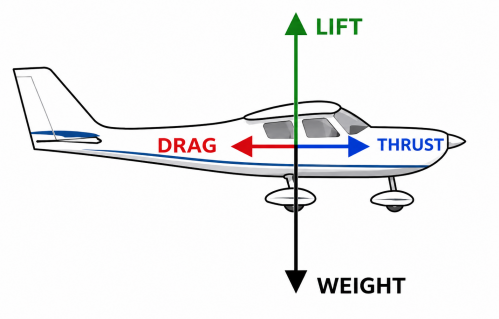
There are four main forces acting on an aircraft in flight:
- Lift
- Weight
- Thrust
- Drag
Lift
Lift is produced when air flows over an aerofoil, such as a wing or rotor blade.
Lift acts at 90° to the Relative Airflow.
Drag
Drag is the aerodynamic force which opposes the aircraft's movement through the air.
Drag acts parallel to the Relative Airflow and opposite to the direction of flight.
Weight
Weight is the force of gravity acting on the aircraft.
It acts vertically towards the centre of the Earth through the aircraft's Centre of Gravity (CoG).
Thrust
In an aeroplane or gyrocopter, thrust is normally produced by the propeller or jet engine and provides the force required to overcome drag.
In a helicopter, the rotor provides the aerodynamic force required to support and move the aircraft.
Straight and Level
For an aircraft to remain in steady straight and level flight, it must maintain a constant:
- height
- airspeed
- direction
In straight and level flight:
Lift = Weight
and
Thrust = Drag
The aircraft is in a state of equilibrium, meaning there is no acceleration.
Turning
An aircraft travelling in a straight line will continue in that direction unless acted upon by a force.